
The short answer
30-second summary- Most workplaces in England have had to separate recyclable materials and food waste since 31 March 2025.
- Micro-firms with fewer than ten full-time equivalent employees have until 31 March 2027.
- There is no universal three-bin rule. What you need depends on your waste and your collector’s arrangements.
For most businesses, the requirements have applied since 31 March 2025. Businesses qualifying as micro-firms have until 31 March 2027. The practical question is not simply whether you have a recycling bin; it is whether your containers, staff routines and collection arrangements handle the required materials correctly.
What changed in March 2025
Workplaces must separate the relevant recyclable materials from residual waste and keep food waste separate. The rules cover household-like waste arising at businesses and other non-domestic premises, including waste from staff and visitors. A waste collection contractor can advise on the containers and collection arrangements that suit each site.
- Dry recyclables: glass, metal, plastic, paper and card.
- Food waste: collected separately, even at workplaces producing only small quantities.
- Residual waste: materials not accepted in the recycling streams.
The deadlines that matter
31 March 2025 was the implementation date for workplaces generally. The temporary micro-firm exemption lasts until 31 March 2027 and depends on fewer than ten full-time equivalent employees across the business, not on headcount at an individual branch. Separate requirements for plastic film also take effect from 31 March 2027; the exact accepted materials and collection arrangements should be checked against current guidance.
Does everything need its own bin?
Not necessarily. Plastic, metal and glass may be collected together under the applicable rules. Paper and card are normally collected separately from these materials; a collector may co-collect them only where the legal conditions are met and a written assessment supports that decision. Food waste must remain separate from dry recycling and residual waste. The number of bins is therefore determined by the lawful collection arrangement and the waste actually generated—not by a universal three-bin formula.
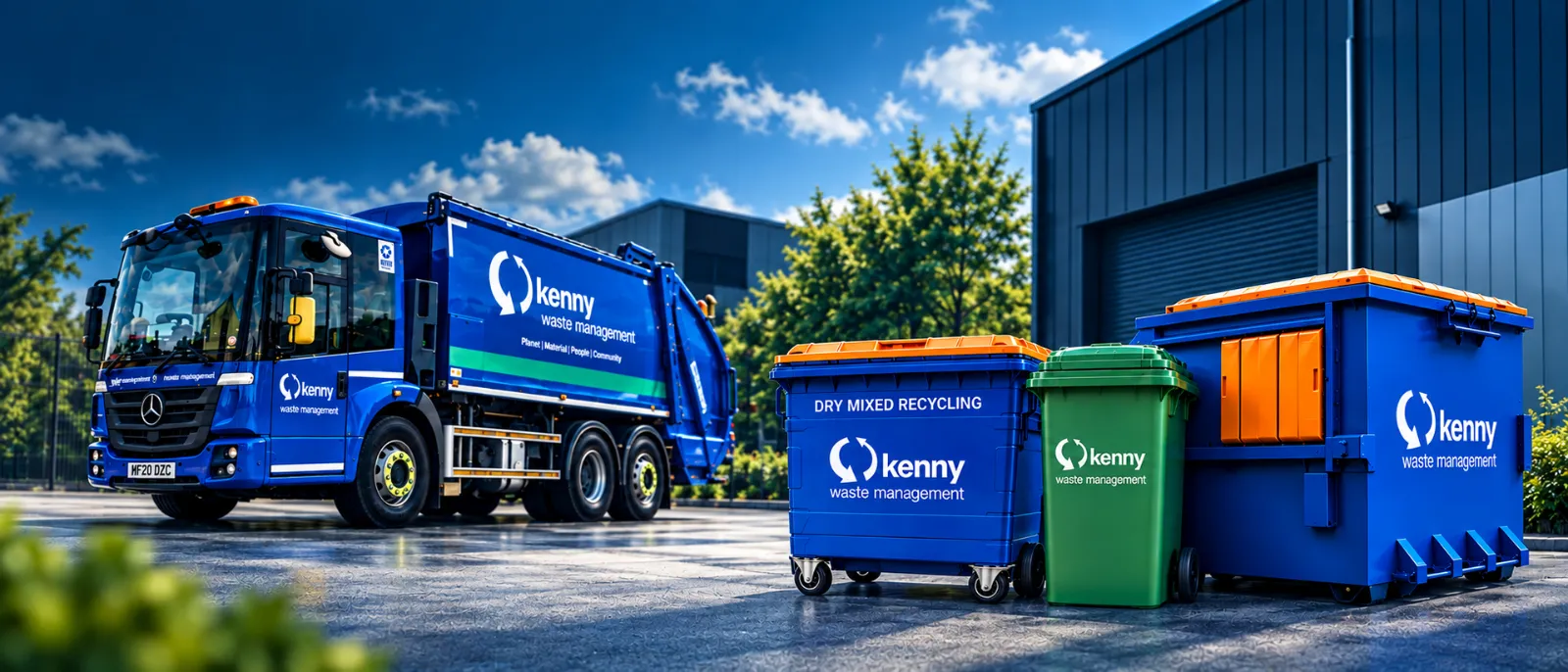
How paper and cardboard are collected can differ between collectors and areas. Where a Kenny Waste Management service is covered by a written co-collection assessment, accepted paper can go in the dry mixed recycling (DMR) container. Corrugated cardboard is often collected separately, because many recycling outlets take it as its own grade. Our guide to paper and card explains when each arrangement applies.
How to assess your workplace
Start with a simple walk-through of where waste arises, where it is stored and who moves it. A compliant collection arrangement can still fail in practice if food waste is tipped into the general bin at the end of a shift or if a shared bin store has no clear instructions.
- Identify waste from kitchens, desks, production areas, visitors and external contractors.
- Check bin labels, placement, capacity, access and collection frequency.
- Confirm whether paper and card have a separate collection or an evidenced co-collection arrangement.
- Confirm food waste provision, including small staff kitchens.
- Check your collector’s registration and retain appropriate duty-of-care documentation.
The next useful step
If you already have recycling collections, request a review of the current streams and the paperwork behind them. If you are preparing for the 2027 deadline, begin with the volume of food waste, paper and card you actually generate. This gives your collector something useful to design around.
Frequently asked questions
Is Simpler Recycling already law?
Yes. The workplace requirements generally took effect on 31 March 2025 in England, with a temporary exemption for qualifying micro-firms until 31 March 2027.
Is one mixed recycling bin enough?
Not automatically. The answer depends on the materials accepted and the lawful arrangements for paper and card; food waste and residual waste must be kept separate.
Do offices need food waste bins?
Yes, the government guidance says food waste must be collected separately even where there is no catering operation or only a small amount is produced.
Does this apply in Scotland and Wales?
This guide addresses the Simpler Recycling rules for England. Other UK nations have different requirements.
This guide is general information for businesses in England. It is not legal advice.


