
Manufacturing and Industrial Waste Management
We help manufacturers and industrial businesses plan collections and equipment around the production process, the space available and the materials that come off the line.
How can we help?
Manufacturing and industrial sites produce waste that reflects what they make. A packaging plant, a metal fabricator and a furniture maker each have very different waste, and a set-up designed for offices won’t work for any of them.
Understanding your waste profile
The first step is understanding what the site produces, where and how much. Typical streams include:
- cardboard and plastic packaging from incoming materials
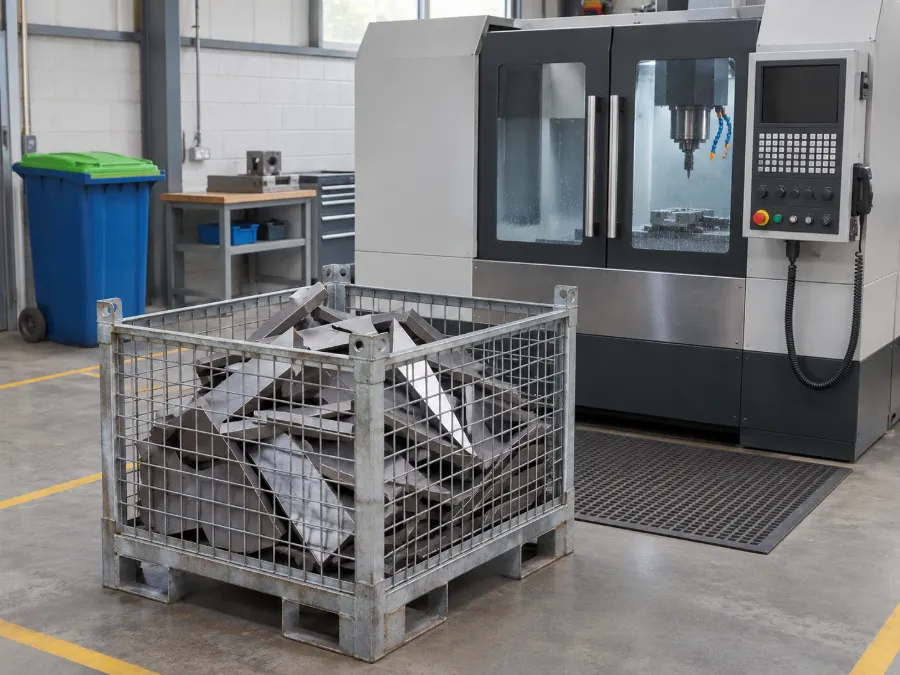
- production offcuts, such as metal, timber, plastic or textiles
- pallets, drums and other bulky transit packaging
- general waste from production areas, offices and canteens
- food waste from staff areas
Some industrial waste needs specialist handling. Process residues, oily swarf, coolants, solvents and chemical containers may be hazardous. They need classifying before anyone can say how they should be collected.
Wheelie bin sizes
Our wheelie bins come in four sizes. Bag equivalents are a rough guide to how much each one holds, and we’ll help you choose the right mix for your space and volumes.
Producing larger volumes? Ask about our front end loader containers.
How it works
- 1Tell us about your siteWhat you produce, where you are and how often you need collections.
- 2We recommend a set-upContainers, collection days and recycling streams sized to your space and volumes.
- 3Bins arrive, collections startWe deliver your containers, confirm your schedule and stay on hand if anything changes.
Equipment for higher volumes
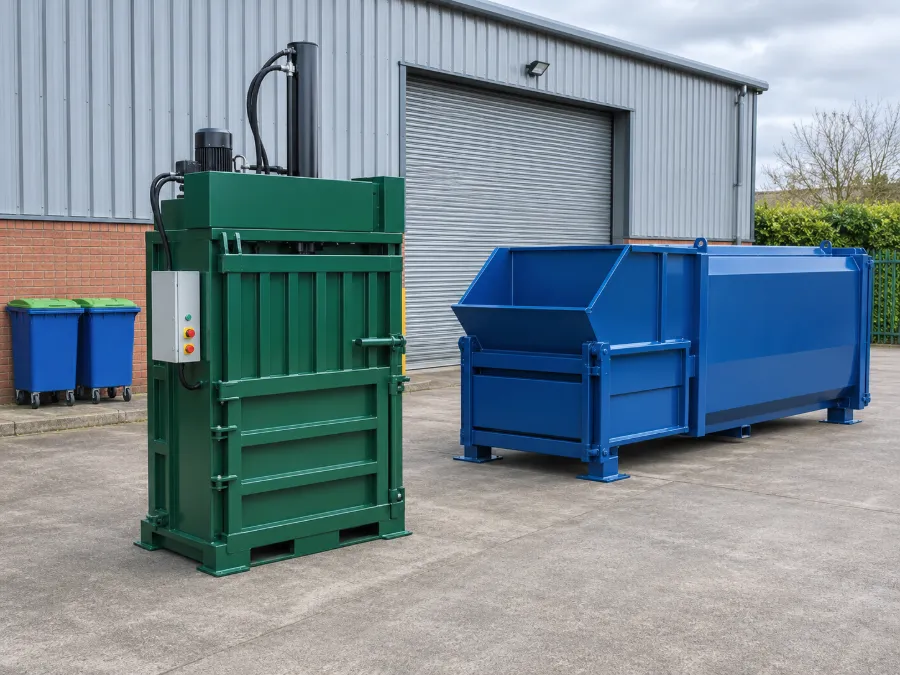
Where volumes are high, the right equipment can save space, labour and collections:
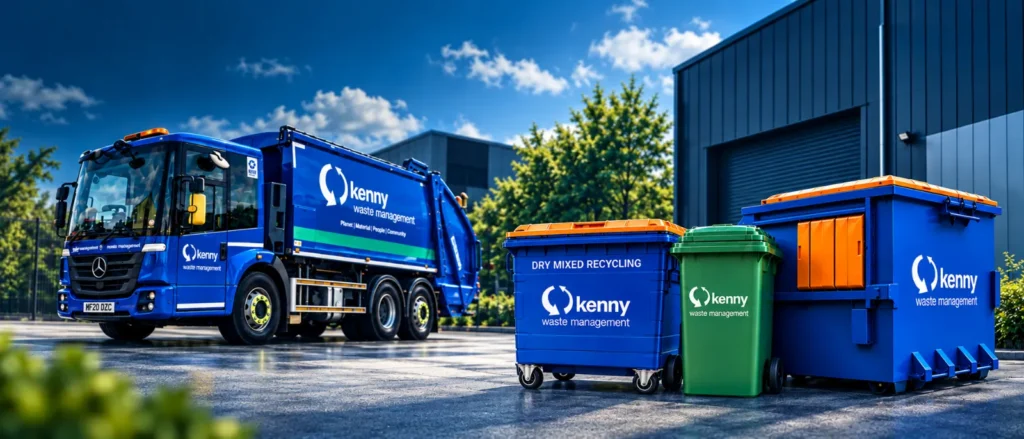
- Front-end-loader containersFor larger quantities of light, compactable recyclables and general waste
- RoRo containersFor bulky or heavy production waste
- BalersTo compress cardboard or plastic film into bales that are easier to store and handle
- CompactorsTo reduce the volume of suitable general waste or recyclables
Equipment only makes sense if the volumes and space justify it, so we’ll look at the numbers with you first.
Segregation on the factory floor
Production waste is often cleaner and more consistent than mixed commercial waste. That makes it more recoverable if it’s kept separate. Simple steps include:
- containers placed near the point where waste is produced
- consistent colours and signs across the site
- training for new staff and shift teams
- regular checks for contamination
Simpler Recycling applies to factories and workshops, so dry recyclables and food waste from canteens and staff areas must be separated too.
Waste information and reporting
If you’re working towards ISO 14001 or reporting on environmental performance, accurate waste information matters. Depending on your account, we can provide collection records and waste data to support that work.
Need a waste service for your factory or plant?
Tell us what you produce, where you are and how often you need collections, and we’ll recommend a practical set-up.

Simpler Recycling: what the law requires
You must separate dry recyclables (plastic, metal, glass, paper and card), food waste and general waste before collection. That includes waste from customers and visitors, and food waste must be separated even if you don’t have a kitchen.
We can help you set up containers and collections that fit these rules, but the duty to separate waste stays with your business. Read the official Simpler Recycling guidance on GOV.UK.
Read our Simpler Recycling guide for businesses.
Better waste data
Depending on your account, you can see your services, collection history and waste data online. It helps with internal reporting, audits such as ISO 14001, and spotting ways to reduce waste and cost.
- 24/7 online portal for your account
- Auditable and secure collection records
- A clear dashboard showing what has been collected
Areas we cover
We collect business waste across Greater Manchester and the North West. Find your local area:
Frequently asked questions
Can waste equipment reduce our collections?
For suitable materials and sites, balers, compactors or larger containers can reduce the number of collections needed. We’ll assess whether it’s worthwhile.
How do we start with a complex waste profile?
Share descriptions of your waste, approximate quantities and your site layout. We’ll start with an initial assessment.
Can production offcuts be recycled?
Often, yes, particularly clean metal, timber, cardboard and some plastics. Contamination and material type affect what’s possible.
Related sectors
Accredited and audited



Why North West businesses choose Kenny
- Family business since 1985, based in Worsley and collecting locally every day
- A dedicated Account Management Team, not a call centre
- Clear contracts with no hidden costs
- Duty of Care paperwork included
- Accredited: CHAS, Constructionline, FORS Silver, SMAS Worksafe and Living Wage Employer
Ready to sort your business waste?

TOTAL WASTE MANAGEMENT
Business Waste Collections

-
He was very helpful and polite good job x

Heather Huggins
I have been using this company over a year now in Manchester and hasn’t let me down they also looks after around... Read more
Paul Bradbury
I highly recommend this company for all waste needs, they are second to none.. we were let down by a... Read more
NICOLA Bell
-
They are fairly priced, reliable and have professional and helpful drivers, I highly recommend them.
Nick Lidgett
Great customer service
David Barker
Fantastic service. Prompt delivery and prompt collection. Highly recommend 👌 would most definitely use Kenny waste management again. They did an amazing... Read more
sarah riley
-
Working closely with Daniel Strange has been fantastic, we lacked a lot of communication before this and Daniel has not only helped... Read more
Phil Jackson
Fantastic service sexcellent customer service 👌prompt professional and friendly easy going super quick replies. So helpful.
M N Hussain
Commercial waste disposal skips and waste collection
Jordan Hurst
-
We’ve had a very positive experience working with Kenny Waste. The service has always been reliable, professional and well organised. Wictoria has... Read more
Filip Grufik
A huge thank you to Claire Lawlor and the amazing team for providing such outstanding customer service. Everyone is friendly, professional, and... Read more
Claire Firbank
Straightforward skip hire. Easy to contact over the phone. Delivered the skip next day. I was finished with it early, gave them... Read more
Aoife Mc M
-
I use Kenny Waste for our commercial hazardous waste removal, their facilities team member Wiktoria is main point of contact who... Read more
Lawrence
Great waste management business. Have used them many times. Staff are brilliant.
Marcus Castle
Great service from Kenny Skips! Had two skips delivered recently for home renovations & they’ve been great. Deliver on time, collect on... Read more
Calleigh Turner
-
Excellent service from Kenny Waste Management. I’ve worked with them on a number of skip hire jobs through my business, D Rowsons... Read more
Dan Rowson
Fantastic service and helpful staff on the phone.
David Lloyd
I have used this company for years and never had a problem. Great service as always especially from Grace! Thank you.
H B


